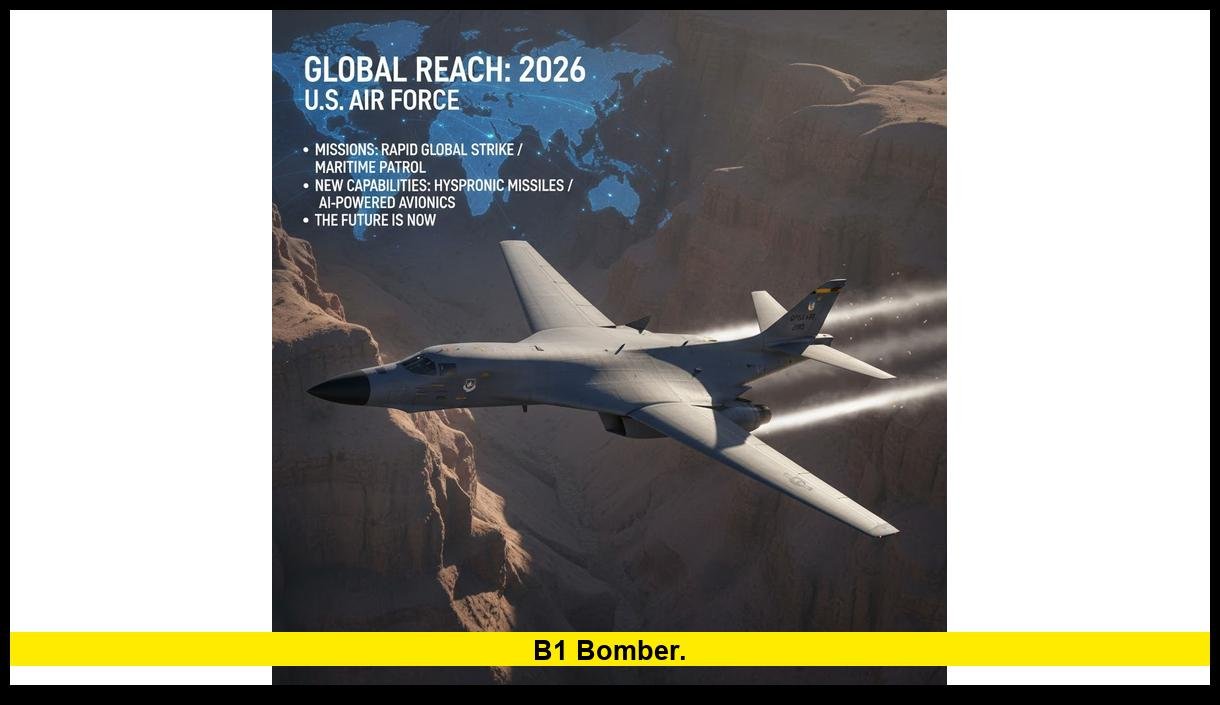
The B1 bomber is a supersonic U.S. Air Force long-range aircraft used for conventional global strike missions and strategic deterrence.
The B1 bomber remains a critical U.S. Air Force asset in 2026, with ongoing global deployments, structural upgrades, and expanded strike capabilities confirmed through active military operations and defense planning. Despite being one of the Air Force’s oldest bombers, the B-1B Lancer continues to play a central role in U.S. conventional deterrence strategy across Europe, the Indo-Pacific, and the Arctic.
As of early 2026, the aircraft is neither retired nor sidelined. Instead, it is actively flying Bomber Task Force missions, receiving hardware and software upgrades, and serving as a bridge platform while the next-generation B-21 Raider enters service.
What Is the B1 Bomber?
The B1 bomber, officially designated the B-1B Lancer, is a long-range, heavy bomber operated exclusively by the United States Air Force. It first entered operational service in the mid-1980s and was originally designed to penetrate Soviet air defenses at supersonic speed.
Over time, its mission changed significantly.
Today, the B-1B is a conventional-only strike aircraft. It no longer carries nuclear weapons, but it remains unmatched in payload capacity among U.S. bombers. Its ability to deliver large volumes of precision-guided munitions over intercontinental distances keeps it highly relevant in modern warfare.
Key defining traits include:
- Supersonic dash speed
- Variable-sweep wings
- Extremely large internal weapons bays
- Long-range global reach
- Compatibility with modern stand-off weapons
Current Status of the B1 Bomber Fleet in 2026
As of February 2026, the U.S. Air Force maintains an active but reduced B-1B fleet, following the retirement of several airframes over the past few years. Remaining aircraft are concentrated at:
- Dyess Air Force Base, Texas
- Ellsworth Air Force Base, South Dakota
Rather than phasing the platform out abruptly, the Air Force is managing the B-1B through selective modernization and structural life-extension programs. This approach allows the bomber to remain combat-credible while avoiding excessive sustainment costs.
Operational readiness levels have improved compared to earlier years, driven by focused maintenance reforms and targeted upgrades.
Bomber Task Force Missions: Where the B1 Bomber Is Flying Now
Indo-Pacific Operations
The Indo-Pacific remains one of the most active theaters for B-1B deployments. Throughout 2025 and into 2026, B-1 bombers have rotated through forward locations to support regional deterrence missions.
These deployments emphasize:
- Rapid response capability
- Long-range maritime strike
- Integration with allied air forces
- Presence operations near contested regions
B-1Bs regularly conduct training flights alongside regional allies, reinforcing interoperability while remaining flexible and unpredictable in their basing.
European and NATO Missions
In Europe, the B1 bomber continues to support NATO deterrence objectives. Aircraft deploy periodically to northern and eastern Europe, where they participate in:
- Joint training with allied fighter aircraft
- Long-range strike simulations
- Arctic and cold-weather operations
- Rapid dispersal drills
These missions demonstrate the aircraft’s ability to operate from unfamiliar bases while maintaining mission readiness.
Arctic and High-Latitude Presence
The B-1B’s range and speed make it well-suited for Arctic operations. In recent rotations, bombers have flown missions that highlight U.S. capability to project power into high-latitude regions with minimal warning.
Such operations reinforce strategic messaging while testing the aircraft’s performance in extreme conditions.
Why the B1 Bomber Still Matters
Despite its age, the B-1B occupies a unique niche in the U.S. bomber fleet.
Unmatched Payload Capacity
The B-1B can carry more conventional weapons internally than any other U.S. bomber. This allows a single aircraft to strike multiple targets in one sortie.
Payload advantages include:
- Large numbers of precision-guided munitions
- Flexible weapon configurations
- High sortie efficiency
This capability reduces the number of aircraft required for complex strike missions.
Speed and Flexibility
Unlike stealth-focused bombers, the B-1B combines speed with payload. Its supersonic dash capability allows it to reposition quickly, complicating enemy planning.
The aircraft excels in:
- Time-sensitive targeting
- Rapid reinforcement scenarios
- Dynamic mission retasking
Conventional Deterrence
While no longer nuclear-armed, the B1 bomber plays a major role in conventional deterrence. Its presence signals U.S. capability and intent without escalating to nuclear postures.
This makes it especially valuable in gray-zone and regional conflict scenarios.
Modernization Efforts Extending the B1 Bomber’s Life
External Weapons Pylons
One of the most significant upgrades underway involves the integration of external heavy-stores pylons. These allow the B-1B to carry additional stand-off weapons beyond its internal bays.
Benefits include:
- Increased missile loadout
- Greater mission flexibility
- Enhanced maritime strike capability
This modification supports long-range operations in contested environments.
Hypersonic Weapon Compatibility
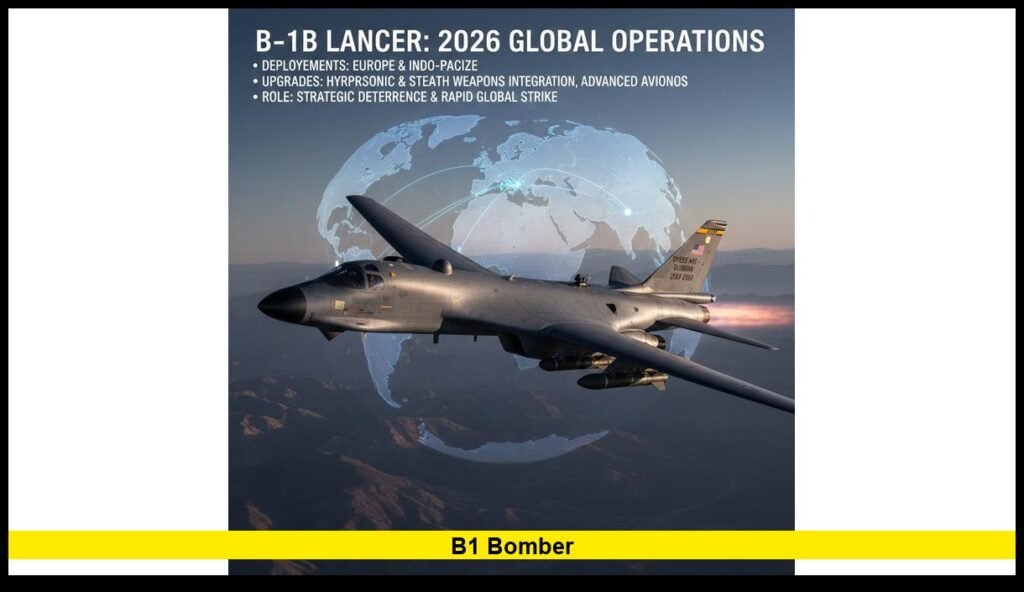
The Air Force is preparing the B-1B to support hypersonic weapons through modular external mounting solutions. While not stealthy, the bomber’s payload capacity makes it well-suited for carrying large experimental weapons.
This role allows the B-1B to contribute to future strike concepts without requiring deep penetration of defended airspace.
Avionics and Communications Upgrades
Modern combat requires secure, fast, and resilient data sharing. The B-1B is receiving avionics enhancements that improve:
- Digital communications
- Tactical data link connectivity
- Situational awareness
- Identification systems
These upgrades ensure the aircraft can operate seamlessly alongside fifth-generation fighters and joint force elements.
Structural Life-Extension Work
A major challenge for the B-1B fleet has been airframe fatigue. To address this, the Air Force is replacing key fuselage sections on selected aircraft using advanced digital modeling techniques.
This effort:
- Extends service life
- Improves safety margins
- Reduces long-term maintenance risk
Only aircraft deemed structurally viable receive these upgrades.
Operational Challenges Facing the B1 Bomber
While still effective, the B-1B faces several real-world limitations.
Maintenance Demands
The aircraft’s complex design requires intensive maintenance. Variable-sweep wings, aging wiring, and structural wear increase downtime.
The Air Force has responded by:
- Retiring non-viable airframes
- Concentrating resources on fewer aircraft
- Streamlining sustainment processes
Lack of Stealth
Unlike newer bombers, the B-1B lacks low-observable characteristics. This limits its survivability against advanced integrated air defense systems.
As a result, it relies heavily on:
- Stand-off weapons
- Escort support
- Electronic warfare integration
Relationship Between the B1 Bomber and the B-21 Raider
The B-1B is not being replaced overnight. Instead, it is serving as a transition platform while the B-21 Raider gradually enters service.
Complementary Roles
In the near term:
- The B-21 focuses on stealth penetration
- The B-1B delivers massed conventional firepower
This combination gives commanders multiple options across the conflict spectrum.
Gradual Drawdown, Not Sudden Retirement
Current planning points toward a phased reduction of the B-1B fleet later this decade. Aircraft will leave service as:
- Maintenance costs rise
- B-21 numbers increase
- Operational needs shift
Until then, the B-1B remains fully mission-capable.
Public and Strategic Perception
The B1 bomber continues to attract attention during overseas deployments. Its size, speed, and distinctive profile make it a visible symbol of U.S. airpower.
For allies, its presence reassures.
For adversaries, it complicates planning.
This psychological dimension remains an important part of its value.
The B1 Bomber’s Role in 2026 and Beyond
In 2026, the B-1B Lancer is neither obsolete nor ceremonial. It is an actively deployed, upgraded, and strategically relevant aircraft.
Its mission has evolved, but its importance has not faded.
As long as the Air Force needs:
- Large conventional payloads
- Rapid global reach
- Flexible strike options
the B1 bomber will remain part of the equation.
What are your thoughts on the B1 bomber’s continued role as the U.S. Air Force transitions to a new generation of aircraft? Share your perspective and check back for the latest updates.