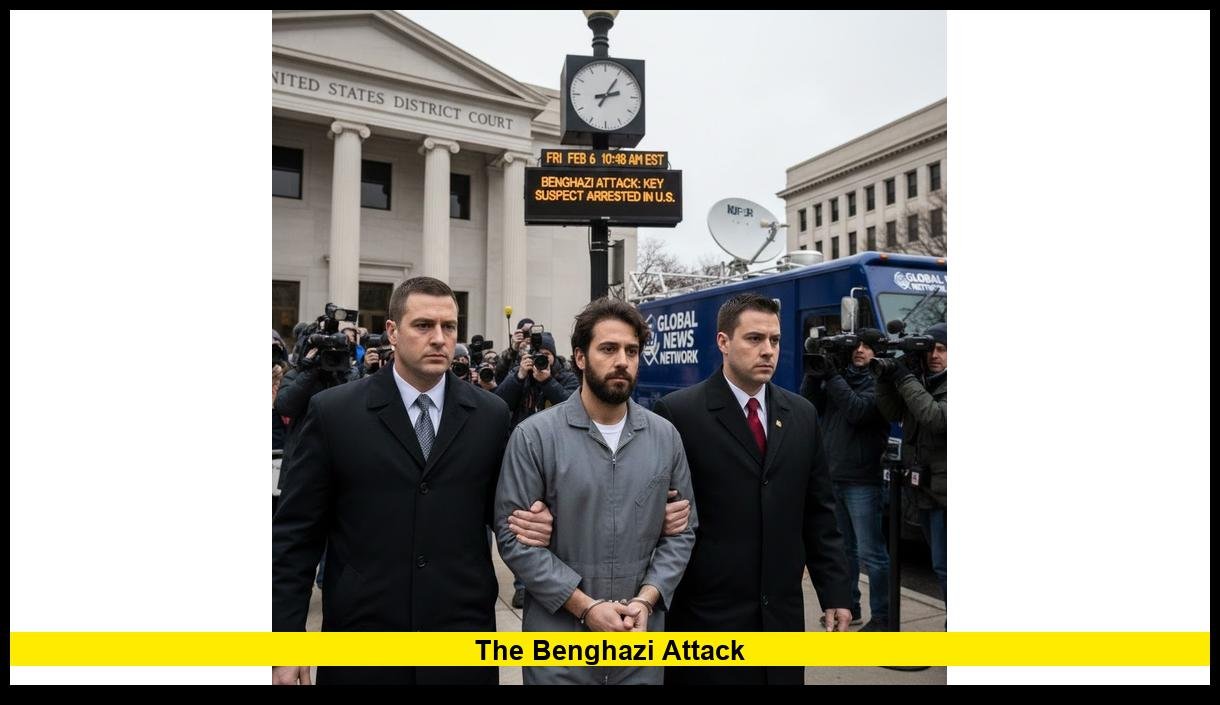
The Benghazi attack was a coordinated terrorist assault on the U.S. diplomatic mission in Benghazi, Libya, on September 11, 2012, that killed four Americans.
The Benghazi attack remains a central issue in U.S. national security and justice, following the recent arrest and transfer to U.S. custody of a key suspect linked to the deadly 2012 assault in Libya. Federal officials confirmed that this development represents one of the most significant legal steps in years connected to the case, renewing public attention on accountability for the attack that killed four Americans.
What Happened During the Benghazi Attack
On September 11, 2012, heavily armed militants launched a coordinated assault on the U.S. diplomatic compound and a nearby CIA annex in Benghazi, Libya. The attack unfolded over several hours and resulted in the deaths of four U.S. personnel:
- U.S. Ambassador J. Christopher Stevens
- State Department information officer Sean Smith
- CIA security contractors Glen Doherty and Tyrone Woods
The attackers used automatic weapons, rocket-propelled grenades, and incendiary devices. U.S. investigations later determined that the assault was a planned terrorist operation rather than a spontaneous demonstration.
The Benghazi attack quickly became one of the most scrutinized foreign policy incidents in modern U.S. history, raising serious questions about diplomatic security, intelligence warnings, and crisis response.
Recent Arrest Marks Major Breakthrough
In February 2026, the U.S. Department of Justice confirmed the arrest and extradition of Zubayr Al-Bakoush, a Libyan national accused of playing a leadership role in the Benghazi attack. Authorities stated that he was taken into custody overseas and transported to the United States, where he will face federal prosecution.
Officials described the arrest as the result of years of intelligence gathering and international cooperation. The suspect is expected to be formally arraigned in U.S. federal court in Washington, D.C.

Charges Filed in Federal Court
Federal prosecutors disclosed that Al-Bakoush faces an eight-count indictment related to the Benghazi attack. The charges include:
- Murder of U.S. nationals
- Acts of terrorism transcending national boundaries
- Conspiracy to provide material support to terrorists
- Arson and destruction of U.S. government property
If convicted on all counts, he could face life imprisonment. Prosecutors emphasized that the charges reflect the seriousness of the attack and its impact on U.S. diplomatic operations worldwide.
Statements From U.S. Officials
Attorney General Pam Bondi stated that the arrest demonstrates the U.S. government’s long-standing commitment to pursuing those responsible for the Benghazi attack, regardless of how much time has passed. Senior officials from the FBI and federal prosecutors were present when the suspect arrived in U.S. custody.
Law enforcement leaders noted that terrorism investigations often span decades, particularly when suspects operate in unstable regions. They stressed that justice for the victims and their families remains a priority.
Previous Convictions Related to Benghazi
The arrest follows earlier prosecutions tied to the Benghazi attack. In 2014, U.S. forces captured Ahmed Abu Khattala, who was later convicted on terrorism-related charges in a U.S. federal court. After appeals and resentencing, Khattala received a 28-year prison sentence.
Another suspect, Mustafa al-Imam, was convicted and sentenced in 2020 for his role in the attack. These cases established legal precedent for prosecuting foreign militants involved in attacks on U.S. facilities abroad.
Security Failures and Investigations
Multiple U.S. investigations examined the circumstances surrounding the Benghazi attack. Congressional committees and independent reviews identified serious security shortcomings at the Benghazi compound, including insufficient staffing and inadequate physical defenses.
While the investigations criticized decision-making processes and risk assessments, they did not conclude that criminal misconduct occurred among senior U.S. officials. The findings instead emphasized systemic failures in diplomatic security planning during periods of political instability.
Political Impact in the United States
The Benghazi attack became a defining political issue in the years that followed. Congressional hearings and public debates focused heavily on how the Obama administration handled intelligence warnings and early public statements after the attack.
The issue played a prominent role during the 2016 presidential election cycle and continued to influence discussions about transparency, accountability, and national security policy. Public opinion remained deeply divided, with supporters and critics interpreting the investigations differently.
Why the Case Still Matters
The recent arrest underscores that the Benghazi attack is not a closed chapter. U.S. officials view the case as a reminder that attacks on American diplomats carry long-term consequences for those responsible.
Beyond legal accountability, the case continues to shape how the United States approaches diplomatic security in high-risk regions. Lessons learned from Benghazi have influenced embassy construction standards, emergency response protocols, and intelligence coordination worldwide.
Ongoing Commitment to Accountability
Federal authorities have indicated that investigations related to the Benghazi attack remain active. They have not ruled out additional arrests if new evidence emerges or if other suspects are located.
The case reflects a broader U.S. policy position: individuals who target American personnel abroad will be pursued, prosecuted, and held accountable under U.S. law, even many years after an attack occurs.
What do you think about the renewed developments in the Benghazi attack case? Share your thoughts below and stay updated as the story continues to unfold.