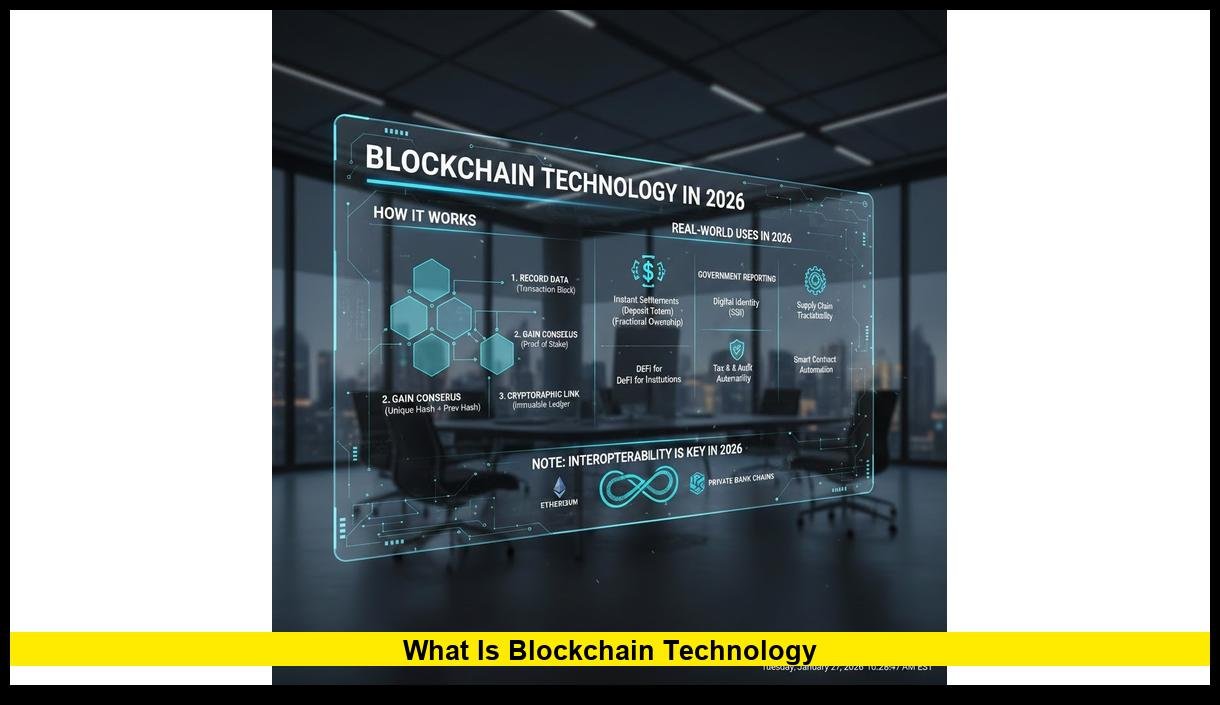
Blockchain technology is a decentralized digital ledger that securely records and verifies transactions across a distributed network of computers.
Blockchain technology is a decentralized digital ledger system that securely records transactions across multiple computers, and today it is actively reshaping U.S. financial markets, government reporting, digital infrastructure, and corporate operations as institutions increasingly adopt blockchain for transparency and efficiency. Major investment firms and regulators are now positioning blockchain at the heart of future economic systems, and new use cases are emerging rapidly.
What Is Blockchain Technology?
Blockchain technology is a secure method of storing and verifying data that eliminates the need for central authorities. It functions by linking data records in sequential “blocks” that are cryptographically secured and distributed across a network of computers known as nodes. Each node keeps a synchronized copy of the ledger, which ensures data integrity and prevents tampering.
Unlike traditional databases controlled by single organizations, blockchain systems rely on consensus rules to validate data, providing a trustless environment where no individual participant controls the network. This makes blockchain especially useful for applications where transparency, security, and decentralization are priorities.
How Blockchain Technology Works
When a transaction or data entry occurs, the information is broadcast to the network and validated by multiple nodes based on agreed protocols. Verified data is bundled into blocks. Cryptographic linking of blocks ensures that once recorded, information cannot be altered without network consensus. This creates an immutable history that’s visible and verifiable by all participants.
Key operational features include:
- Distributed Ledger: All network participants store the same transaction history.
- Cryptographic Security: Data is protected against unauthorized changes.
- Consensus Mechanisms: Systems like proof-of-stake ensure agreement on validated data.
- Permanent Records: Once confirmed, data is stored permanently and transparently.
These properties enable blockchain networks to function without centralized control while offering strong security and reliability.
Core Characteristics of Blockchain Technology
Decentralization
Blockchain distributes data across many users rather than relying on a single central system, reducing single points of failure and increasing resilience.
Immutability
Once recorded and confirmed across the network, transactions cannot be changed or erased, making blockchain ideal for audit trails and tamper-resistant ledgers.
Transparency
Public blockchains allow anyone to view transaction histories, creating trust through visibility rather than institutional authority.
Security
Blockchain uses advanced cryptographic techniques to protect against fraud and hacking.
Latest U.S. Adoption and Regulatory Developments
Blockchain technology’s influence in the U.S. is expanding in finance, government data, and regulatory policy:
- In early 2026, a financial services firm filed with U.S. regulators to tokenize shares of a Treasury bill ETF on a blockchain, enabling 24/7 trading, instant settlement, and reduced transaction costs while maintaining compliance with traditional securities laws.
- Federal agencies have begun recording official economic data on public blockchain networks, demonstrating government confidence in blockchain’s immutability and transparency.
- In 2025, a major nationwide policy summit in Washington, D.C. convened regulators and industry leaders to discuss digital asset frameworks and blockchain policy, signaling how central blockchain discussions have become to U.S. innovation strategies.
Institutional interest in blockchain continues to rise even as regulatory clarity evolves, with stablecoins and tokenization identified as key themes shaping how digital assets and blockchain systems integrate with traditional finance. Use of blockchain for programmable compliance and jurisdiction-aware networks is gaining focus among developers and regulators alike.
Blockchain Technology in Real-World Use Today
Blockchain’s role extends far beyond cryptocurrency:
Finance and Digital Markets
Blockchain is increasingly used to modernize settlement systems, enabling near-instant trade settlement and around-the-clock markets. Tokenization of traditional financial instruments — such as stocks, bonds, and ETFs — is pushing digital assets toward mainstream infrastructure.
Smart Contracts
Automated agreements known as smart contracts execute business logic when conditions are met. These are transforming workflows in real estate, insurance, and corporate compliance by cutting costs and reducing manual oversight.
Government and Public Data
Applications now include recording economic statistics and other official data on blockchain for public verification, showcasing its utility beyond financial instruments.
Enterprise and Sustainability
Corporations are using blockchain to track carbon credits, emissions data, and environmental reporting with immutable audit trails. This enhances credibility for sustainability initiatives and ensures transparent reporting for shareholders and regulators.
Cross-Border Payments and DeFi
Blockchain enables faster, cheaper cross-border transactions with reduced intermediaries. Decentralized finance, or DeFi, is leveraging blockchain to offer lending, borrowing, and trading services outside traditional banking channels.
Key Trends Shaping Blockchain in 2026
Several prominent trends are defining how blockchain technology is evolving:
- Tokenization of Real-World Assets: Digital versions of tangible assets are being created and traded on blockchain networks, improving liquidity and broadening investor access.
- Layer-2 Scaling and Interoperability: Solutions that increase transaction throughput and connect different blockchains are driving efficiency and cross-chain capabilities.
- AI Integration: Artificial intelligence is being combined with blockchain to enhance smart contract logic and automate complex decision-making processes.
- Stablecoin Infrastructure: As regulatory frameworks become clearer, stablecoins are increasingly viewed as foundational components of future payment systems.
- Enterprise Adoption: Blockchain use for global payments, supply chain tracking, and trusted audit trails is growing in corporate environments.
Benefits of Blockchain Technology
Blockchain technology delivers measurable advantages:
| Benefit | Impact |
|---|---|
| Faster settlements | Near-instant transaction confirmation |
| Lower costs | Minimizes intermediaries and processing fees |
| Stronger security | Cryptographically protected records |
| Transparency | Shared visibility among participants |
| Greater resilience | No central point of control or failure |
These benefits are driving blockchain adoption among financial institutions, regulators, government agencies, and corporations.
Challenges Facing Blockchain Today
Despite gains, challenges remain:
- Scalability: Some networks struggle with high transaction volumes.
- Regulatory Clarity: U.S. policy is still evolving, although progress is ongoing.
- Security and Infrastructure: Risks often lie in surrounding systems such as digital wallets or exchanges rather than the underlying blockchain.
Ongoing developments in standards, interoperability, and compliance mechanisms are helping address these challenges.
The Future Role of Blockchain Technology
As of 2026, blockchain technology is transitioning from a niche experiment into foundational digital infrastructure across industries. Its adoption in regulated financial markets, government data systems, and enterprise operations signals a lasting shift in how data, assets, and trust are managed digitally. Financial institutions are embedding blockchain into settlement, custody, and asset tokenization systems to reduce processing time and operational risk. At the same time, public agencies are using blockchain for secure recordkeeping, data verification, and transparency initiatives, reflecting growing institutional confidence in distributed ledger technology.
Blockchain is also becoming a core component of enterprise architecture. Large corporations are deploying blockchain to support supply chain traceability, environmental reporting, intellectual property protection, and cross-company data sharing. These implementations prioritize efficiency, auditability, and compliance, positioning blockchain as a practical tool rather than an experimental solution. Improvements in scalability, interoperability, and energy efficiency are accelerating adoption across permissioned and public networks alike.
Looking ahead, blockchain is expected to play a central role in secure data sharing, financial innovation, digital identity, and decentralized business models that empower users and organizations alike. Self-sovereign identity systems are enabling individuals to control personal credentials without reliance on centralized databases. Tokenization of real-world assets is expanding access to investment opportunities and increasing market liquidity. Meanwhile, blockchain-based platforms are supporting new governance models that emphasize transparency, automation, and user participation. As regulatory frameworks mature and technology continues to evolve, blockchain is poised to serve as a foundational layer for trusted digital interaction in the modern economy.
Conclusion
Blockchain technology is a powerful innovation for secure, transparent, and decentralized recordkeeping. From tokenized financial markets and smart contracts to public economic data and enterprise sustainability tracking, blockchain is influencing key sectors across the U.S. economy. As adoption grows and use cases expand, blockchain will continue shaping the way digital systems operate and interact in a connected world.
What is blockchain technology changing in your industry? Share your thoughts below and stay engaged as this technology continues to evolve.